Zoned Heating Is a System, Not a Gadget: What UK Homes Misunderstand About Smart TRVs
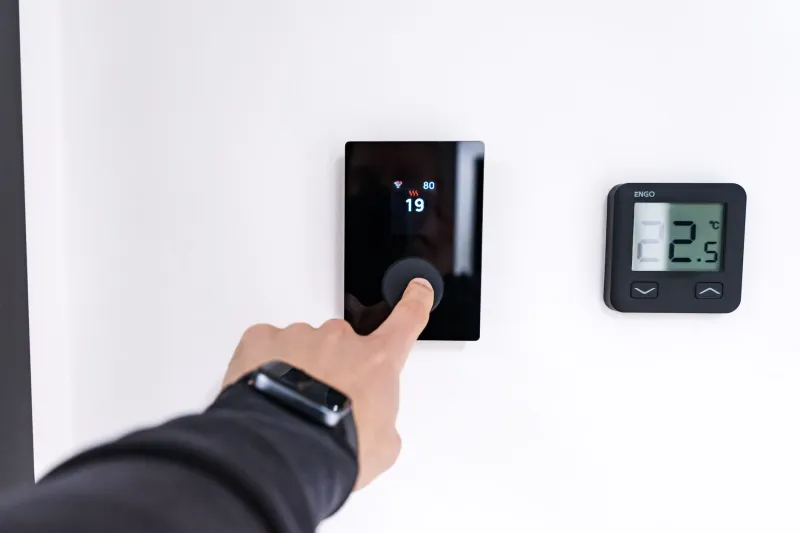
Smart thermostatic radiator valves have become the default symbol of a modern heating upgrade. They promise room-by-room schedules, app control and the suggestion that a household can stop heating empty rooms and watch the savings appear. In some UK homes, that promise is broadly fulfilled. In many others, the valves are installed, the schedules are set, and the gas bill barely moves.
The explanation is not that smart TRVs are useless. It is that they are controls at the endpoint of a system that has to be balanced, commissioned and operated as a whole. A valve can close a radiator; it cannot redesign the hydraulic behaviour of the house.
The promise and the shortfall
The sales case is simple: heat only the rooms you use. The technical reality is more conditional. A smart TRV can reduce demand in a room, but the boiler still has a minimum output, the pump still produces pressure, and the remaining radiators still have to absorb the heat. If the system is not balanced, closing one radiator can push more flow to another, raise return temperatures and encourage the boiler to cycle.
That is why two households can install similar valves and report very different outcomes. The difference is rarely the app. It is the state of the heating system beneath it.
A valve cannot balance a system
Hydraulic balancing is the process of adjusting lockshield valves so that every radiator receives a proportionate share of flow. In an unbalanced system, the radiator closest to the boiler often gets more water than it needs, while distant radiators run cool. A smart TRV on a cool radiator may open fully and still fail to heat the room, because the underlying flow is wrong.
Balancing should be treated as a prerequisite, not an optional extra. The installer should measure flow and return temperatures across radiators, identify the index circuit and adjust the lockshields accordingly. Without that step, smart TRVs are being asked to compensate for a fault they cannot correct. In some cases, the valves will create noise at high pump pressure, or the boiler will short-cycle as small zones open and close.
Flow temperature is the quiet multiplier
A condensing boiler is most efficient when it condenses, which generally requires a return temperature below the dew point of the flue gases—often quoted as around 54C for natural gas, though the exact figure depends on conditions. Many UK homes still run at a flow temperature of 70C or higher because the radiators were sized for that regime. Smart TRVs do not change that.
If the goal is real savings, the flow temperature has to be part of the conversation. Weather compensation, OpenTherm controls or a lower fixed flow temperature can improve condensing performance, provided the emitters are large enough to heat the rooms at design conditions. For heat pumps, low flow temperatures are not optional; they are the basis of efficient operation. Zoning on a heat pump without attention to water volume, emitter size and defrost behaviour can create more problems than it solves.
Schedules are not the same as zoning
A room schedule is a time-based instruction. Zoning is a control strategy that accounts for how heat moves between rooms, how the building responds and how the heat generator behaves. The two are often confused.
In a Victorian terrace with solid walls and high thermal mass, switching a room off for a few hours may not save much, because the walls and contents retain heat and the room has to be reheated from a cooler base. In a lightweight new-build flat, the response may be faster, but airtightness and ventilation losses dominate. A schedule that ignores door closures, solar gain and internal heat gains can create comfort complaints without reducing energy use.
Setback is often more effective than shutdown. A modest reduction in setpoint in unused rooms, combined with a well-balanced system, is usually more predictable than repeatedly heating and cooling a space.
Zone valves versus smart TRVs
Motorised zone valves divide a heating system into larger areas, typically by floor or extension. They are simple, robust and useful where pipework is already separated into circuits. They offer less granularity than smart TRVs, but they also create fewer control interactions and are easier to commission.
Smart TRVs offer room-level control, which is genuinely useful in homes with variable occupancy, home offices or spare rooms. But they depend on a bypass or sufficient open radiators to maintain flow, and they need careful setting of minimum and maximum valve positions to avoid starving the boiler or heat pump.
For a heat-pump-ready layout, the priority is low flow temperature and adequate emitter area, often with larger radiators or underfloor heating. Zoning should follow the hydraulic design, not be added as an afterthought. A buffer cylinder or a minimum open volume may be needed to keep the heat pump stable when several TRVs close at once.
Metrics that reveal whether zoning is working
Households do not need a building management system to judge whether zoning is delivering. A few metrics, recorded over comparable weeks, are enough to expose the difference between activity and effectiveness.
Track boiler cycles per hour. If zoning has reduced demand but the boiler is cycling more, the minimum output or water volume may be mismatched. Track flow and return temperatures, if the system exposes them. A condensing boiler that never drops its return temperature is unlikely to be capturing the efficiency gain that the controls imply.
Track room overshoot: the gap between the setpoint and the actual temperature after the heating turns off. Large overshoot suggests the valve is slow, the room is gaining heat from elsewhere, or the flow temperature is too high. Track time to setpoint for each room and compare it with the thermostat history before zoning was introduced.
Finally, track energy use per degree day rather than raw monthly consumption. A colder month will always use more energy, so a like-for-like comparison is essential. If energy per degree day does not fall after a zoning change, the system is not delivering the claimed benefit—or the benefit is being taken as improved comfort rather than reduced consumption.
A realistic verdict
Smart TRVs are a useful layer of control, but they are not a substitute for commissioning. The UK homes that benefit most are those with a balanced system, sensible flow temperatures, adequate emitters and realistic schedules. The homes that struggle often have the valves installed first and the system investigated later.
In 2026, with heat pumps becoming more common and tariffs increasingly time-sensitive, the case for room-level control is stronger than ever. But the case for treating zoning as a system is stronger still. Buy the valves if they solve a specific control problem. Do not buy them expecting them to correct a hydraulic one.