Before You Call the Glazier: A Dew-Point Diagnosis for Misty Windows
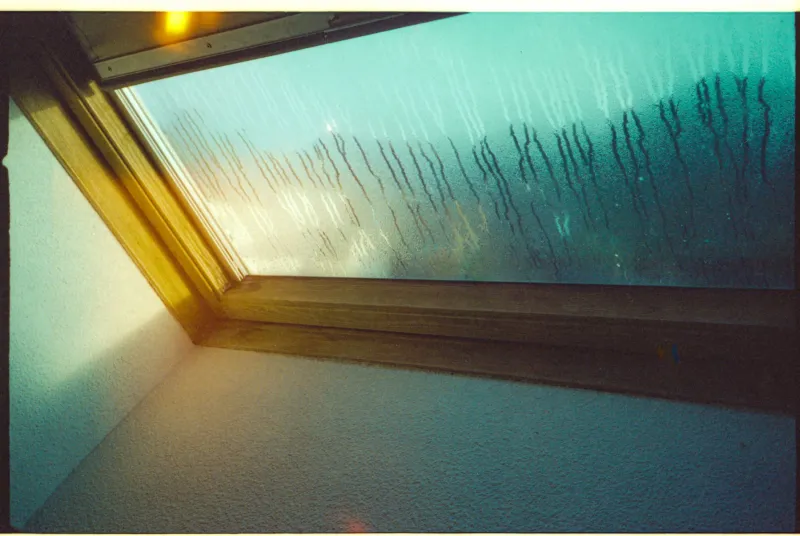
Misty windows are one of the most reliable prompts for a glazing quotation in the UK. The sight of water running down a bedroom pane on a cold morning feels like evidence of failure. Yet internal condensation is not a diagnosis in itself. It is a symptom with several possible causes, and only some of them belong to the window.
A dew-point test is a practical way to separate the candidates. It does not require a laboratory or a costly survey. A hygrometer, an infrared surface thermometer and, where available, a thermal camera can establish whether the glass is simply the coldest surface in a moist room, whether a particular edge is disproportionately cold, or whether the sealed unit has lost its insulating gas or barrier.
What the dew point actually tells you
Air holds water vapour in proportion to its temperature. The dew point is the temperature to which that air must be cooled before it becomes saturated and water begins to condense. In a room at 20°C and 50% relative humidity, the dew point is roughly 9°C. At 60% relative humidity it rises to about 12°C; at 70% it is close to 14°C. The higher the indoor moisture load, the warmer the glass must be to stay clear.
That relationship matters because UK homes often sit in the 50–65% relative humidity range during winter, particularly in bathrooms, kitchens and bedrooms where clothes are dried. A single-glazed or poorly performing pane may fall below the dew point while the room itself is adequately heated. In that case the window is not necessarily defective. It is simply the first surface to reach saturation.
The test therefore compares two numbers: the dew point of the room air and the temperature of the glass surface. The difference between them is the margin. A positive margin means the surface is above the dew point. A negative margin means condensation is expected.
Tools and a controlled measurement
A basic hygrometer suitable for this work costs £10–£30. It should display relative humidity and temperature, and many will calculate dew point directly. An infrared surface thermometer costs £15–£40. A thermal camera is useful but not essential, and it must be used with care on glass.
Measure after the room has been at its normal heating pattern for at least half an hour. Keep curtains open and avoid measuring immediately after a shower, cooking or tumble-drying unless that is the condition under investigation. Record the room air temperature and relative humidity, then take surface temperatures at four points: the centre of the glass, the lower edge of the glass, the frame or reveal beside it, and an adjacent internal wall.
Repeat the measurement in the morning and again in the evening. A single reading can mislead, particularly in a room that is warmed intermittently.
Reading the margin
A useful rule of thumb is to treat a margin above 3°C as comfortable, a margin between 0°C and 3°C as marginal, and a negative margin as a condensation risk. If the room is at 20°C and 60% relative humidity, the dew point is around 12°C. A glass centre at 14°C has a 2°C margin: clear for now, but vulnerable on a colder night. A glass centre at 10°C has a negative margin and will mist.
The pattern matters as much as the number. Uniform misting across the whole pane, especially when relative humidity is above 60%, points towards indoor moisture and insufficient ventilation. Misting confined to the edges and corners, with a clear centre, suggests a cold spacer bar, a thermally weak frame or cold bridging at the reveal. Water or mist between the panes is a different matter altogether: it usually indicates a failed sealed unit, and replacement of the unit or window is the relevant remedy.
A room-by-room reading
In a bathroom, a negative margin shortly after a shower is expected. The question is whether the glass clears within a reasonable period and whether the extract fan is moving enough air. In a kitchen, persistent condensation near the window often coincides with cooking moisture and a recirculating extractor hood that filters grease but does not exhaust air outside.
In a bedroom, condensation can follow overnight occupancy. Two adults can add a meaningful moisture load simply by breathing, and closed doors and curtains reduce air movement. If the dew-point margin is negative only in occupied bedrooms, ventilation and background heating are usually the first things to examine. If the margin is negative in an unoccupied room, the glazing or the surrounding fabric is more likely to be the weak point.
A thermal camera can help trace the pattern, but it should not be trusted for absolute glass temperature. Glass has low emissivity and reflects radiation from the room, so a camera may report a misleading figure. Use the camera to compare frame temperatures, reveals, wall junctions and ceilings, and use a contact or infrared thermometer, with appropriate emissivity settings, to confirm the glass reading.
Choosing the next spend
If relative humidity is high and the dew point is close to the room temperature, replacement glazing is unlikely to solve the problem on its own. The first spend should be on ventilation: repairing or upgrading extract fans, clearing trickle vents, considering background ventilation or mechanical ventilation with heat recovery where appropriate, and reducing moisture at source. A dehumidifier can provide short-term relief, but it is not a substitute for adequate air exchange.
If relative humidity is moderate, the glass is consistently cold and the margin is negative at the centre of the pane, improved glazing, secondary glazing or better curtains and blinds may be justified. Draught-proofing can help comfort, but it should be balanced against ventilation needs; tightening a home without managing moisture can simply move condensation to another cold surface.
If mist appears between the panes, or if the edge seal has visibly deteriorated, the case for replacement is stronger. That is a sealed-unit failure rather than a humidity problem, and no amount of ventilation will restore the insulating cavity.
A dew-point test is not a substitute for a professional survey, but it is a useful first filter. It turns a vague complaint about misty windows into a measured comparison between air and surface, and it helps direct the next payment towards the measure most likely to make the room drier, warmer and more predictable.