Reading the Stack: A November Thermal Survey of the Victorian Chimney Breast
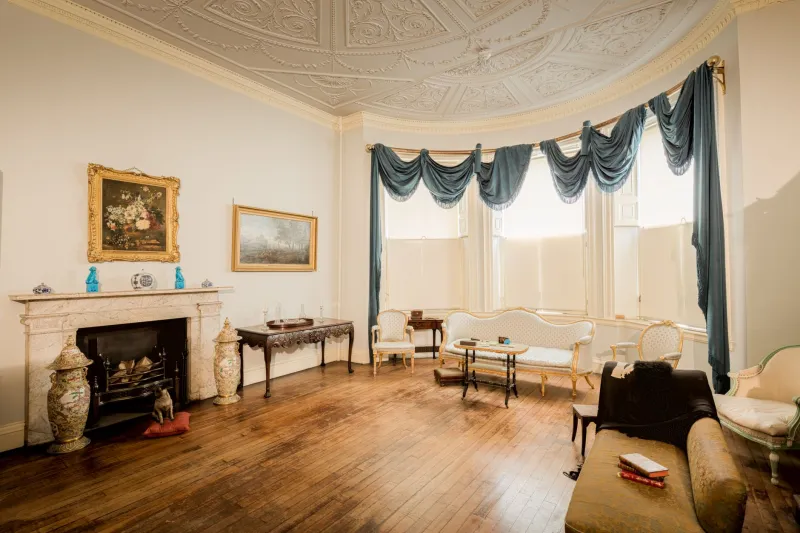
The chimney breast is one of the most misunderstood thermal components in a Victorian or Edwardian terrace. It is treated as furniture, or as a period feature, or as a problem to be hidden behind plasterboard. In thermal terms, however, it is a vertical shaft through the building envelope, surrounded by masonry of varying thickness and penetrated by a flue that may or may not still be doing useful work. On a still, cold November evening, with the heating running and the wind off the house, that shaft often reveals itself.
Why the stack reads differently in November
A Victorian terrace with a disused front-room fireplace still contains a flue. The fireplace opening may have been blocked, plastered over or fitted with a decorative surround, but the flue itself usually remains a continuous void from hearth level to chimney pot. In winter, the temperature difference between the heated room and the outside air creates a pressure drive. Warm air is buoyant; a vertical flue gives it a route upward. The result is not a dramatic gale but a persistent, low-level exchange: warmed indoor air leaves through the stack, and cooler outdoor air finds its way back in through gaps around the fireplace, skirting and floorboards.
That exchange gives the chimney breast a thermal signature. It is not always a simple cold rectangle. Solid masonry has thermal mass, so the breast may hold its temperature longer than the surrounding wall. A camera can therefore show a cool vertical band, a cold hearth, or a patchy pattern at the edges of the opening. The important question is not whether the breast is cold, but whether the pattern changes with wind and with the heating cycle.
Inside the room: interpreting the thermal pattern
A useful internal survey begins with stable conditions. Run the heating long enough for surface temperatures to settle, keep the room free of direct sunlight, and record the outdoor temperature and wind direction. A thermal camera should be used at a consistent angle, with the fireplace opening and the adjacent wall in the same frame. The adjacent wall is the reference: it shows what the room surface would look like without the flue path.
Look for a cool plume or band running up the breast, particularly at the edges of the opening and around any former register plate. Check the hearth as well. A cold hearth with warm air above it can indicate air movement rather than simple conduction. Do not rely on a single image. Take a sequence over ten to fifteen minutes and note whether the pattern strengthens when the wind rises or when the heating first comes on.
Emissivity matters. Soot, matt black paint and bare plaster behave differently from glazed tiles and metallic trims. A shiny surface can read as colder or warmer than it is. The camera is a guide to surface temperature, not a direct measurement of air leakage. Use it to locate the likely path, then confirm with a smoke pencil or a low-speed anemometer at the fireplace opening.
Outside: stack, pot and flaunching
The external survey is just as important. On a cold, overcast morning, a thermal camera can show warm air leaving an uncapped pot, but the pattern is easily confused with solar gain on the stack. Survey before the sun reaches the chimney, and compare the pot with neighbouring stacks of similar construction. Visible defects matter too: missing mortar, cracked flaunching, open pots and failed bird guards all change how the flue behaves.
An open pot is not proof of a problem, but it is a prompt. A flue that is no longer connected to a appliance should be capped or otherwise sealed against rain and birds while still allowing appropriate ventilation. A flue that serves a gas appliance must be left alone by the householder and assessed by a Gas Safe registered engineer.
The open-flue mechanism
An uncapped or unballooned flue behaves like a permanent open vent. In a Victorian terrace, that matters because the original ventilation strategy often depended on uncontrolled leakage. The chimney was part of it. When the fireplace is no longer used, the flue can become an unmanaged extract route: warmed air leaves at the top, and cold air enters at the bottom. The effect is modest in absolute terms but continuous, and it is at its most noticeable on the still, cold evenings when the heating is working hardest.
This is why a chimney balloon or a purpose-made chimney draught excluder can produce a visible change in a thermal survey. It is also why the change should be measured rather than assumed.
Measuring before and after a draught excluder
Establish a baseline first. Record internal and external temperatures, wind conditions and the heating set point. Take thermal images of the breast and opening from the same position. Use a smoke pencil at the fireplace opening to observe air movement, and an anemometer if available. Note any ventilation openings elsewhere in the room; do not seal a flue in isolation if the room depends on that path for combustion air or general ventilation.
After fitting an appropriate draught excluder, repeat the survey under similar conditions. The thermal pattern may not disappear, because the masonry still has thermal mass and the breast may remain cooler than the surrounding wall. What should change is the dynamic behaviour: less cold air spilling into the room, less warm air escaping, and a weaker response when the wind rises. Record the difference rather than claiming a precise energy saving. The value of the survey is evidence, not a sales figure.
Safety boundary: when not to block
A flue that serves a gas fire, back boiler, boiler or any other gas appliance must not be blocked by the householder. Blocking it can cause combustion products to spill into the room, and carbon monoxide is not detectable by smell or by a thermal camera. Any work on such a flue is a Gas Safe registered engineer's task. The same caution applies to flues serving solid fuel appliances and to any flue whose function is uncertain.
A thermal audit is diagnostic, not a licence to seal. If the survey shows a strong draught path and the flue is genuinely disused, a proper chimney draught excluder may be appropriate, with ventilation maintained where required. If there is any doubt about what the flue serves, stop and seek professional advice.
A practical sequence for the chimney breast
First, confirm what the flue serves. Second, survey inside and outside under controlled conditions. Third, record a baseline with thermal images, a smoke pencil and, if possible, an anemometer. Fourth, take advice before installing any permanent restriction. Fifth, fit an appropriate draught excluder only where it is safe to do so. Sixth, repeat the survey and keep the records.
The Victorian chimney breast is not simply a cold patch on a wall. It is a route through the thermal envelope, and in November it often shows its hand. Reading that hand correctly is the difference between a useful efficiency measure and an expensive mistake.