The Eighteen-Degree Evidence Standard: Auditing Winter Warmth at Bed Height
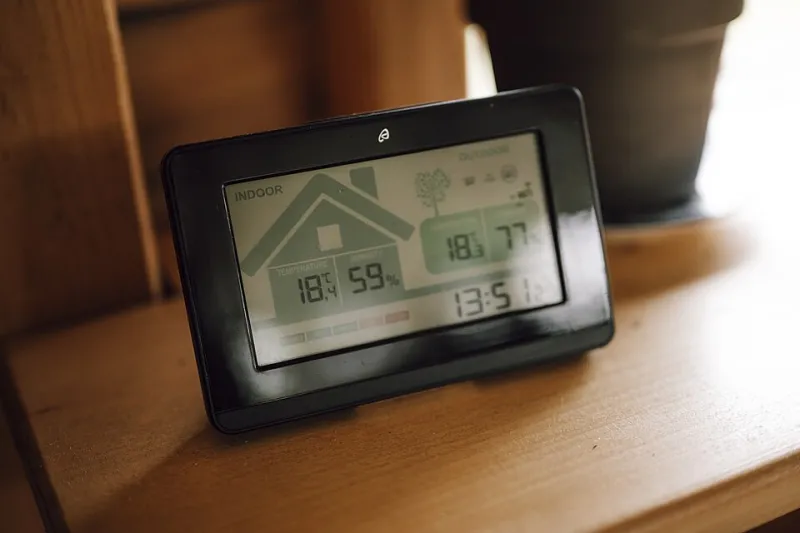
Photo: Shixart1985, CC BY 2.0, via Wikimedia Commons
The return of cold-health alerts to the UK conversation for winter 2026 has given the familiar 18°C figure renewed attention. It is a useful benchmark, but it is also easily misused. A smart thermostat showing 18.4°C in a hallway does not establish that a bedroom, living room or home office is holding that temperature at the height where someone actually sits or sleeps. The figure is not a promise made by a heating system; it is an evidence standard that has to be tested in the right place, at the right height, over the right period.
For households trying to act on cold-health advice without overbuying technology, the first task is an audit of what existing smart heating data can and cannot prove. The second is to close the most common measurement gaps with simple, repeatable checks.
What the 18°C line actually asks of a sensor
Public health guidance commonly uses 18°C as a reference for rooms in everyday use, with particular attention to bedrooms where overnight warmth matters for older people, infants and anyone with a health condition. The exact wording varies by source, but the practical implication is consistent: the temperature that counts is the one experienced by the occupant, not the one displayed on a device in another room.
That distinction matters because air temperature is not uniform within a house. Warm air stratifies. Hallways behave differently from bedrooms. A sensor mounted at 1.5 metres on a hallway wall may read several tenths of a degree higher than the air at pillow height in a bedroom, and the gap can widen when doors are closed, curtains are drawn and radiators have cycled off. A single thermostat is a control device, not a whole-home thermometer.
Hallway bias and the myth of one number
Many UK homes have their primary thermostat in a hallway, often close to the front door or the foot of the stairs. That position was chosen for convenience and wiring, not for thermal representativeness. It can be influenced by draughts from the letterbox, heat from a nearby cupboard, or the dead air of a stairwell. In some houses, the hallway reads warmer than the bedrooms simply because it is smaller and better enclosed; in others, it reads cooler because of a cold front door.
The result is a familiar mismatch: the thermostat satisfies its setpoint while a bedroom remains below the benchmark. The opposite can also occur, with the hallway pulling the system into longer runs than the occupied rooms require. Neither pattern can be diagnosed from a single displayed number. The audit has to compare rooms, not defend one reading.
Placement rules for sensors already in the home
Before buying anything, inventory the sensors already present. Smart thermostats, radiator valves, room sensors and boiler controllers all report temperature, but they do so from different positions and with different biases. A TRV sensor sits close to the radiator and will often read high while the radiator is hot and low when it is off. A thermostat on an internal wall may be reasonably placed; one beside a window or above a radiator is not.
For an occupant-height audit, use a separate room thermometer or a movable smart sensor where possible. Place it at roughly 0.6 metres for a seated occupant and 1.1 metres for bed height, away from external walls, direct sunlight, radiators, lamps and draughts. Leave it in place long enough to stabilise, ideally several hours. Record the reading alongside the thermostat reading and the TRV reading so that offsets become visible rather than assumed.
Radiant asymmetry: air temperature is only half the story
A room can hold 18°C of air and still feel cold. This is the problem of radiant asymmetry. A person seated near a single-glazed window or an uninsulated wall loses heat by radiation to a cold surface, even when the air around them meets the benchmark. The effect is not captured by a thermostat, but it is often visible with a thermal camera and detectable by the occupant as a cold side or a draught-like sensation without moving air.
Where a thermal camera is available, check the surface temperatures of the main external walls, window reveals and floor edges in each test room. The aim is not to chase every cold patch but to identify whether a cold surface is close enough to seating or sleeping positions to undermine comfort. If the air reads 18°C and the adjacent wall reads 12°C, the room has a radiant problem that additional heating may only partly solve.
Overnight logging and the bedroom test
Cold-health advice often places particular weight on overnight conditions, so the bedroom deserves its own log. Use the smart heating system's history or a separate data logger to capture readings at 15-minute or half-hourly intervals between 23:00 and 07:00. Record the minimum, the mean and the time spent below the benchmark. A single overnight snapshot is not enough; the pattern matters, especially where set-back schedules reduce output after midnight.
Compare the bedroom log with the hallway thermostat log and with the external temperature. If the bedroom falls below the benchmark while the hallway holds steady, the issue may be door closure, radiator sizing, TRV behaviour or a schedule that treats the bedroom as unoccupied. If both fall together, the question shifts to boiler output, weather compensation or the set-back period itself.
A practical checklist before buying more kit
- Choose the rooms that matter: bedroom, living room and any room used by a person with heightened cold sensitivity.
- Measure at occupant height, not at ceiling height or on a shelf.
- Compare each room reading with the hallway thermostat and the nearest TRV.
- Log overnight temperatures for at least three cold nights.
- Note surface temperatures at windows, external walls and floors where practical.
- Record door and curtain positions during the test.
- Check that schedules and set-backs match actual occupancy.
- Only after these steps decide whether a new sensor, TRV or thermal camera would answer a specific unanswered question.
The final point is important. Smart heating equipment is useful when it closes an evidence gap, not when it adds another dashboard. A household that knows its hallway reads 1.5°C warmer than the bedroom at 06:00 has a diagnostic lead. A household with five sensors and no record of placement has more data but less insight.
The 18°C line is best treated as a question to put to the house: where, at what height, for how long and under what surface conditions? Answering that question with existing smart heating data is usually the most cost-effective first step in a winter warmth audit.