Steam, Sensors and Stolen Warmth: A Bathroom Ventilation Audit for UK Homes

Photo: Diego Delso, CC BY-SA 4.0, via Wikimedia Commons
November is the month when a bathroom tells lies about a heating system. The mirror fogs, the window runs, and the temptation is to blame the thermostat or the radiator. In many UK homes, however, the more consequential device is the small extractor fan in the ceiling. It is installed to remove moisture, but its overrun timer, humidity threshold and interaction with trickle vents can turn it into a controlled — or uncontrolled — route for warm air to leave the building.
This is not an argument against bathroom ventilation. Moisture control is essential, particularly in insulated and draught-proofed homes where water vapour has fewer places to escape. The point is that ventilation and heating are one system in practice. Before commissioning a new smart thermostat or adjusting a schedule, it is worth auditing the bathroom extractor as a heat-loss component in its own right.
Start with the fan’s job description
A bathroom extractor has two related duties: remove odour and remove moisture. UK guidance commonly refers to intermittent extract rates for sanitary accommodation, with typical domestic fans specified around 15 litres per second, though the correct figure depends on the room, the installation and the applicable building regulations. A fan running continuously at that rate moves roughly 54 cubic metres of air per hour. If that air is replaced by outdoor air at 5°C and the room is held near 20°C, the steady ventilation load is in the region of 250 to 300 watts. That is not trivial when it continues for hours because an overrun timer has been set generously.
Intermittent use changes the arithmetic, but not the principle. A fan that runs for 30 minutes after every shower is doing useful work. A fan that runs for 30 minutes after every visit to the bathroom, or that never quite stops because a humidity sensor is set too low, is quietly increasing the air-change rate of the whole dwelling. The thermostat then appears to underperform, when in fact it is heating air that is being expelled.
What a thermal camera can and cannot show
The appeal of thermal imaging here is that it shows the bathroom as a thermal envelope rather than a collection of fittings. A camera will not see air moving, and it will not measure the fan’s airflow directly. What it can show is the cooling effect on surfaces: a cold plume at the top of a door, a chilled patch around the fan grille, or a ceiling that reads cooler than neighbouring rooms after the fan has run.
Useful views include the door head and frame, the fan louvres, the trickle vent, the ceiling around the fan, and the external wall behind the basin. Take a baseline image before the fan is switched on, then another during operation and a third ten minutes after it stops. Look for consistency rather than drama. A small temperature difference may be normal; a pronounced cold band that persists after the fan has stopped suggests that outdoor air is still entering, or that the fan is still extracting.
Emissivity and reflection deserve caution. Glossy tiles, mirrors, chrome fittings and white plastic can all mislead. Keep the camera angle as square to the surface as possible, and use an emissivity setting appropriate to the material. A cold reading on a mirror is not evidence of a cold wall. The camera is most reliable when it is used to compare similar surfaces under similar conditions.
Pressure checks without specialist equipment
A thermal image can suggest a ventilation path, but a simple pressure check can confirm whether the fan is moving air from the room or merely stirring it. Close the bathroom door and window, switch on the fan, and hold a tissue or smoke pencil near the gap under the door. A healthy installation should draw air in through that gap. If the tissue is indifferent, the fan may be starved of replacement air, or the door may be too well sealed for the extract rate.
Repeat the check at the trickle vent, if one is fitted. A vent that whistles or holds a flame at an angle may be admitting more air than intended. A vent that shows no movement while the fan runs may be blocked, painted shut or incorrectly set. Neither condition is automatically a fault, but both affect the balance between moisture removal and heat loss.
For a more measured approach, a handheld differential pressure gauge or a calibrated anemometer at the grille can be used by a competent installer. The aim is not to chase a single number. It is to establish whether the fan has a clear path from replacement air to extract point, and whether that path is open when it should be.
Humidity data beats guesswork
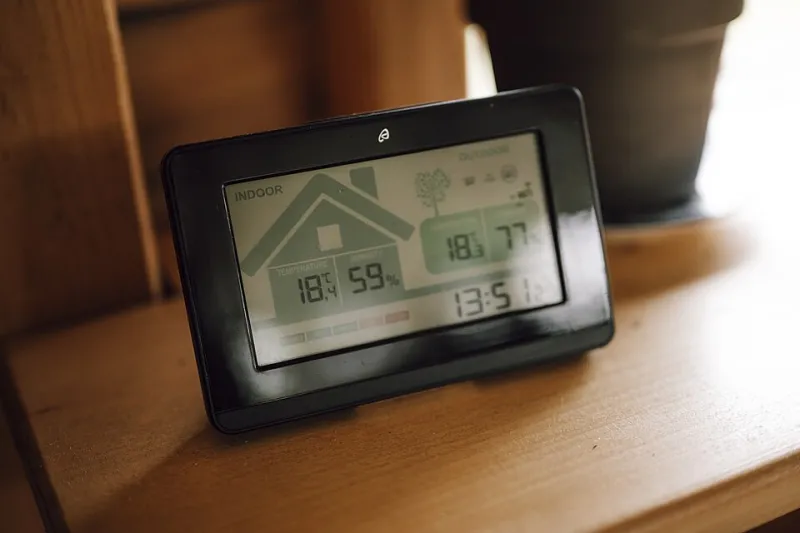
Relative humidity is the most practical control signal for a bathroom fan, but it is also easily misapplied. A cheap hygrometer in the room, or a smart sensor with logging, can record conditions before, during and after use. The useful question is not whether the room feels steamy. It is whether humidity falls back towards the background level of the rest of the home within a reasonable period after the shower or bath.
A fan that continues long after the humidity has normalised is wasting heat. A fan that stops while the mirror is still clearing may leave moisture in the structure. Logging over a week is more informative than a single reading, because it captures different weather, occupancy and drying habits. If the bathroom shares a wall with a bedroom or hallway, compare humidity in both. Moisture that migrates rather than leaves is a sign that local extraction is not working as intended.
Setting smart extractor controls sensibly
Smart extractor controls can improve on a simple timer, but only if they are commissioned with the building in mind. Humidity thresholds should be set above normal background humidity and below the level that produces condensation on the coldest surfaces. Overrun timers should be long enough to clear the room after a shower, but not so long that the fan becomes a whole-house ventilation system by accident. Boost modes should be deliberate, not the default.
Where a fan has a continuous trickle mode, check whether that mode is appropriate for the dwelling. Continuous low-rate ventilation can be useful in airtight homes, but it needs to be balanced against the heating load and the presence of other ventilation. Sealing a trickle vent to stop a draught, while leaving an extractor fan running, is rarely a coherent strategy. The two devices are part of the same air path.
Finally, do not use the extractor as a substitute for fixing a cold surface or a leaking gutter. A fan can remove moisture from the air, but it cannot dry a wall that is being wetted from outside. Thermal imaging is useful precisely because it separates the two: a cold patch that remains after ventilation has normalised is a fabric issue, not a fan issue.
Before upgrading the thermostat, spend an hour on the bathroom. Check the overrun setting, watch the fan during and after use, log the humidity, and look at the door head and grille with a thermal camera. If warm air is being extracted faster than moisture requires, the smartest thermostat in the house will still be heating a moving target.